

Introduction: The Silent App Killer
Performance is not a feature that can be added after the product is built. It is a foundational requirement that decides whether software feels reliable, usable, and ready for scale. A system may pass every functional test and still fail when real users, real data, real traffic, and real business pressure enter the picture.
Most software does not fail suddenly. It slows down first. A dashboard takes longer to load after more data is added. A checkout API responds a few seconds late during peak traffic. A search filter works perfectly for one user but freezes when hundreds of users apply it at the same time. These small delays may look harmless in isolation, but they quietly damage user trust and product adoption.
At Nikqik Technologies, we do not look at software only through the question of whether it works. We validate how it behaves under stress, velocity, concurrency, and chaotic scale. For us, performance testing is not a stopwatch activity. It is a way to understand whether the system can stay stable when pressure increases from every direction.
This is where performance testing becomes critical. It does not only measure speed. It reveals the health of the architecture, the efficiency of the infrastructure, the reliability of the APIs, and the system’s ability to recover when demand crosses expected limits.
The Anatomy of Performance Failures
Performance failure is rarely just about a slow screen. Slow performance is usually the visible symptom of deeper system behaviour. The root cause may sit inside an inefficient database query, a poorly designed API, uncontrolled retries, weak caching, memory leaks, connection pool exhaustion, synchronous processing, or an infrastructure setup that scales too late.
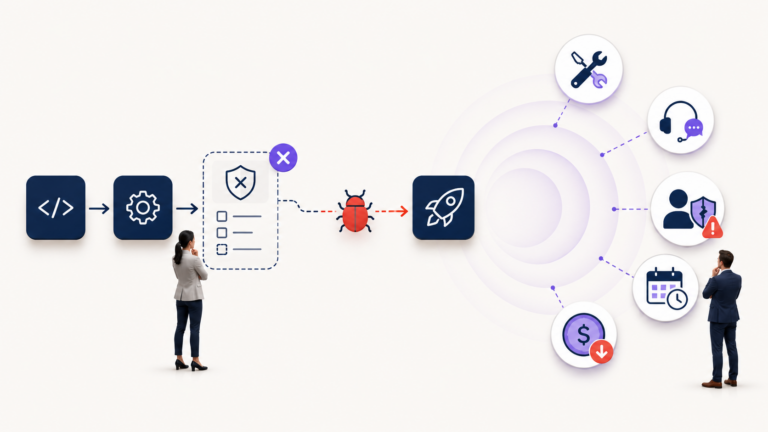
In real-world software environments, performance issues directly affect the business bottom line. A slow system increases support tickets, reduces user adoption, frustrates internal teams, and creates pressure on engineering teams. When the application becomes unreliable under load, the business does not see it as a technical inconvenience. It sees it as lost trust, delayed operations, and higher cost.
One of the most common mistakes teams make is assuming that functional testing is enough. Functional testing answers an important but limited question: does the feature work for one user under controlled conditions? Performance testing asks a broader and more business-critical question: does the same feature continue to work for thousands of users, with realistic data volumes, without breaking dependencies or increasing infrastructure costs unnecessarily?
This distinction matters because modern applications are interconnected. One user action may trigger authentication checks, permission validation, database queries, file retrieval, third-party API calls, notification updates, and background jobs. The frontend may show only one click, but the backend may process multiple operations across different services.
When performance testing is skipped, teams often discover these hidden costs only after production traffic exposes them. The result is usually reactive scaling, emergency optimization, higher cloud bills, and rushed architectural decisions. Adding more infrastructure may temporarily reduce the symptom, but it does not always solve the problem. Sometimes the real issue is not that the system needs more servers, but that it needs better queries, smarter caching, smaller payloads, stronger queue handling, or a different processing model.
How Poor Performance Impacts Business and Architecture
Cloud Infrastructure Costs Start Rising Without Control
Poor performance often makes infrastructure more expensive than it needs to be. When systems are inefficient, teams compensate by increasing server capacity, database size, memory limits, or cloud resources. This may keep the application running for some time, but it can hide the real bottleneck behind higher monthly cloud bills.
A scalable system should not only handle more traffic. It should handle growth efficiently. Performance testing helps engineering and leadership teams understand whether the system is using infrastructure responsibly or simply consuming more resources because of poor design decisions.
Database Bottlenecks Become Production Risks
Databases often become the first serious pressure point during scale. A query that performs well in a development environment may become painfully slow when the table grows to millions of records. Missing indexes, heavy joins, unoptimized reports, long-running transactions, and deadlocks can all appear when traffic increases.
These problems are especially dangerous because they can affect multiple workflows at once. A single expensive operation can slow down user-facing actions, background jobs, dashboards, and API responses. Performance testing helps expose these weaknesses before they turn into peak-hour incidents.
APIs Start Degrading Under Concurrency
APIs may perform well when tested individually, but real-world traffic puts them under concurrent pressure. When many users call the same endpoint at the same time, weaknesses in timeout handling, rate limits, payload size, dependency management, and retry logic become visible.
A slow API does not remain isolated for long. In distributed systems, one degraded service can create a chain reaction. Other services may wait, retry, queue requests, or fail. This is how a small delay becomes a larger reliability issue.
The Core Pillars of Performance Testing
Performance testing is often explained through categories such as load testing, stress testing, soak testing, and spike testing. These labels are useful, but they are not the real value. The real value lies in understanding what each test reveals about the system’s behaviour, limits, and recovery patterns.
At Nikqik, we approach performance testing through engineering questions. We do not run tests only to produce numbers. We use them to understand how the application behaves when traffic, data, users, and infrastructure pressure increase together.
Load Testing: Establishing the Real Baseline
Load testing validates how the system behaves under expected usage and peak business traffic. It helps establish a realistic baseline for performance, capacity, and stability. This baseline is important because teams need to know how the application performs before scale becomes unpredictable.
A strong load test should reflect real user behaviour. Users do not follow perfect scripts. They search, filter, upload, refresh, export, retry, and perform overlapping actions. In B2B SaaS platforms, a single workflow may create multiple backend requests, database operations, role checks, and third-party interactions.
The purpose of load testing is to understand whether normal and expected peak traffic can be handled without unacceptable latency, rising error rates, or resource saturation. It also helps identify which workflows degrade first and which parts of the system need optimization before the next release or growth phase.
Stress Testing: Understanding How the System Breaks
Stress testing pushes the system beyond expected limits to understand its failure behaviour. The goal is not to prove that the system can handle unlimited traffic. No system can. The goal is to understand where the breaking point is and what happens after that point is crossed.
A mature performance strategy does not only ask when the system fails. It asks whether the system fails safely, visibly, and recoverably. This is an important difference. A poorly prepared system may collapse unpredictably, return inconsistent responses, overload the database, or trigger cascading failures across connected services.
A better-designed system degrades gracefully. Non-critical features may slow down before critical workflows. Queues may absorb temporary pressure. Rate limits may protect backend services. Circuit breakers may isolate failing dependencies. Monitoring may alert teams before the issue becomes a complete outage.
Stress testing gives engineering teams the evidence they need to design failure intentionally. Every system has a limit. The difference between a fragile system and a scalable system is whether the team understands that limit before customers discover it.
Endurance Testing: Finding Issues That Need Time to Surface
Endurance testing, also called soak testing, checks how the system behaves under sustained load over a long period. Some performance problems do not appear in short test runs. They need time to build up before they become visible.
Memory leaks, connection leaks, thread exhaustion, cache growth, queue backlog, logging pressure, and gradual database degradation can all stay hidden during short tests. The system may perform well for the first hour and then slowly deteriorate after several hours of continuous use.
This type of testing is especially important for enterprise platforms and business-critical applications. Many systems are not judged by how well they perform for five minutes. They are judged by whether they remain stable throughout business hours, reporting cycles, batch jobs, campaigns, integrations, and heavy user activity.
Endurance testing helps teams detect slow-burning risks before they create production fatigue. It also gives a clearer view of whether the application can remain stable without manual intervention over extended usage periods.
Spike Testing: Testing Shock Absorption
Traffic does not always grow gradually. Sometimes it jumps without warning. A product launch, seasonal campaign, viral post, major client onboarding, Black Friday-style event, or sudden market attention can create a sharp traffic spike.
Spike testing evaluates how the system responds to sudden demand. This is where teams learn whether auto-scaling works fast enough, whether caching is effective, whether queues protect the backend, and whether rate limits prevent overload.
Auto-scaling is useful, but it is not instant magic. New instances need time to start. Load balancers need to distribute traffic properly. Databases may not scale as quickly as application servers. Third-party services may enforce limits. Queue systems may protect the backend but delay user-visible results.
Spike testing reveals whether the system can absorb shock or whether pressure simply moves from one bottleneck to another. For modern SaaS products, this readiness matters because growth can arrive faster than infrastructure teams expect.
The Hidden Architectural Cost of Skipping Performance Testing
Skipping performance testing does not remove the cost. It only moves the cost to a later and more expensive stage. Instead of finding issues during development or controlled testing, teams discover them during production incidents, customer escalations, failed launches, and emergency infrastructure changes.
Without performance evidence, teams often make architectural decisions based on assumptions. They guess traffic capacity, database readiness, API resilience, cloud sizing, and scaling behaviour. This creates a risky operating model because scalability cannot be built on guesswork.
Performance testing gives teams measurable proof. It shows how the system behaves under expected load, where it starts to degrade, which dependencies are fragile, and what needs to change before the next stage of growth. This is why we treat performance testing as a design validation practice, not just a QA activity.
The hidden architectural cost of skipping performance testing is technical debt that becomes visible only under pressure. By that time, the cost of fixing it is usually higher because the product is live, users are affected, and release timelines are already tight.
The Nikqik Approach: Moving Performance Testing Left
Performance testing has traditionally been treated as a late-stage activity. Teams build the application, validate functional behaviour, prepare for release, and then run performance tests close to deployment. This approach creates unnecessary risk because serious performance issues are discovered when the architecture is already difficult to change.
At Nikqik Technologies, we believe performance testing should move earlier into the software development lifecycle. This shift-left approach does not mean running massive load simulations for every small code change. That would be expensive and impractical. It means giving engineering teams the right level of performance feedback at the right stage.
Lightweight API performance checks can be introduced during development. Critical endpoints can have baseline response thresholds in CI/CD pipelines. High-risk workflows can go through performance smoke tests before merging major changes. Database-heavy features can be reviewed earlier for query efficiency and data growth impact.
This approach helps teams catch small regressions before they become architectural problems. A single slow endpoint may not look serious during development, but when it becomes part of a high-volume workflow, it can slow down the entire system.
Moving performance testing left also changes the engineering culture. Performance becomes part of how the team builds software, not something they inspect after everything else is completed. It helps developers, QA engineers, DevOps teams, and product leaders make decisions with better evidence.
What Nikqik Looks for During Performance Testing
A good performance test is not just a traffic simulation. It is an investigation into how the system behaves across layers. Our team looks at the frontend, APIs, databases, infrastructure, background jobs, third-party services, queues, monitoring signals, and recovery behaviour.
We focus on the relationship between user behaviour and system pressure. This means understanding which user actions generate the heaviest backend load, which APIs degrade first, which database queries become expensive with realistic data, and whether background jobs are competing with user-facing workflows.
We also look at whether retries are helping recovery or making the system worse. Uncontrolled retries can create additional pressure during an incident. Similarly, caching can improve performance, but if it is poorly designed, it may introduce stale data risks or hide deeper inefficiencies.
The purpose of this analysis is not only to report that an application is slow. The purpose is to identify why it is slow, where the bottlenecks live, how the system behaves under pressure, and what engineering decisions will improve stability, efficiency, and scalability.
Key Metrics That Actually Matter
Performance testing should not be reduced to average response time. Response time is important, but it does not tell the full story. A system can show acceptable averages while still delivering poor experiences to users at the edge of the distribution.
Engineering leaders need to look at telemetry in a more analytical way. The most useful metrics are the ones that connect user experience, system capacity, infrastructure pressure, and failure behaviour.
Throughput Shows How Much Work the System Can Handle
Throughput measures how much work the system can process within a specific time period. This may be measured as requests per second, transactions per second, jobs processed per minute, messages consumed from a queue, or business-specific operations completed during a test window.
Throughput helps teams understand capacity, but it should never be viewed in isolation. A system may process a high number of requests while latency rises sharply or error rates increase. That is not healthy scalability.
The real goal is sustainable throughput. The system should be able to handle expected business volume while keeping latency acceptable, error rates controlled, and resource usage efficient.
Latency Percentiles Reveal the User Pain That Averages Hide
Average response time can be misleading because it hides the worst user experiences. If most requests are fast but a meaningful percentage are slow, the average may still look acceptable. Users experiencing slow responses will not care that the average looks good on a report.
This is why p95 and p99 latency matter. p95 shows the response time experienced by the slowest five percent of requests, while p99 shows the response time experienced by the slowest one percent. These percentiles reveal tail latency, which is often where the most frustrating user experiences exist.
For SaaS platforms, p99 latency can reveal problems hidden behind average behaviour. A dashboard may load quickly for most users but become slow for users with larger datasets, advanced permissions, complex filters, or heavier workflows. These are often the enterprise users who matter most to the business.
Resource Utilization Shows Where the System Is Paying the Price
Resource utilization helps teams understand how hard the infrastructure is working during load. CPU usage, memory saturation, disk I/O, network bandwidth, database connections, thread pools, queue depth, cache hit ratios, and container limits all provide important signals.
These metrics help separate symptoms from causes. High CPU may indicate inefficient computation, poor serialization, excessive logging, or scaling problems. Memory growth may indicate leaks or poor cache management. High database connections may point to pooling issues. I/O bottlenecks may reveal storage pressure, logging overhead, or inefficient file handling.
Without resource data, teams may only know that the system is slow. With resource data, they can understand why it is slow and what needs to be optimized.
Error Rates Under Load Reveal the Real Breaking Point
A system under load should not only be measured by how fast it responds. It should also be measured by how reliably it responds. Error rates show whether the application remains dependable as pressure increases.
Important error signals include failed transactions, timeouts, rejected requests, HTTP 5xx responses, database deadlocks, queue processing failures, third-party API failures, and retry exhaustion. These errors often reveal the real breaking point of the system more clearly than response time alone.
The pattern of errors also matters. Some systems fail gradually as pressure increases, while others appear stable and then suddenly collapse. Some recover automatically after load drops, while others require manual intervention. Performance testing helps teams understand these patterns before they become production risks.
Performance Testing Is Also a Product Strategy
Performance is an engineering concern, but its impact is strategic. A slow product limits growth. Sales teams may close deals, but poor performance can damage onboarding. Product teams may release new features, but users may avoid them if they feel heavy. Support teams may resolve tickets, but recurring slowness keeps creating new complaints.
For SaaS companies, performance affects customer retention, product adoption, enterprise readiness, support volume, SLA confidence, cloud margins, release quality, and brand trust. This is why performance testing should not sit only inside QA or backend engineering. It should be part of product planning, architecture reviews, DevOps practices, release readiness, and leadership reporting.
When performance becomes part of decision-making, teams build better systems. They choose architecture with evidence, prioritize optimization based on user impact, identify bottlenecks before customers do, control infrastructure costs with data, and release with more confidence.
This is the real value of performance testing. It turns scalability from an assumption into an engineering discipline.
Building a Culture of Performance
Performance testing is not a one-time activity before launch. It is a continuous engineering culture built through repeated measurement, realistic testing, production learning, and architectural improvement.
A scalable system is not created by one large test at the end of development. It is created through discipline across the lifecycle. Teams need to measure early, monitor continuously, test critical workflows, review performance regressions, and improve the system as usage patterns evolve.
At Nikqik Technologies, we help teams move from reactive performance firefighting to proactive scalability engineering. We do not stop at identifying that an application is slow. We help uncover why it is slow, where the pressure points exist, how the architecture behaves under demand, and what practical changes will improve performance.
Modern software cannot afford to treat performance as an afterthought. Users expect speed, businesses expect reliability, engineering teams need visibility, cloud budgets need control, and architectures need proof. Performance testing provides that proof.
Conclusion: Future-Proof Your Software Before Scale Tests It for You
The best time to discover a performance weakness is before users, customers, or infrastructure bills expose it. Once performance issues reach production, the cost is no longer limited to engineering effort. It affects trust, operations, support, revenue, and growth confidence.
Performance testing is the discipline that helps teams understand whether their software is ready for real-world scale. It validates more than speed. It validates stability, resilience, infrastructure efficiency, API reliability, database readiness, and architectural maturity.
Nikqik Technologies partners with businesses to audit, test, optimize, and future-proof their software architecture through practical performance engineering. From API bottlenecks and database pressure to CI/CD performance checks, load simulations, cloud cost efficiency, and resilience validation, our team helps businesses build systems that perform when pressure increases.
If your application is growing, slowing down, preparing for launch, or moving toward enterprise-grade usage, performance testing should not wait until the final release window. It should become part of how your software is built, validated, and improved.
Scalable software is not proven in calm conditions. It is proven under pressure.